






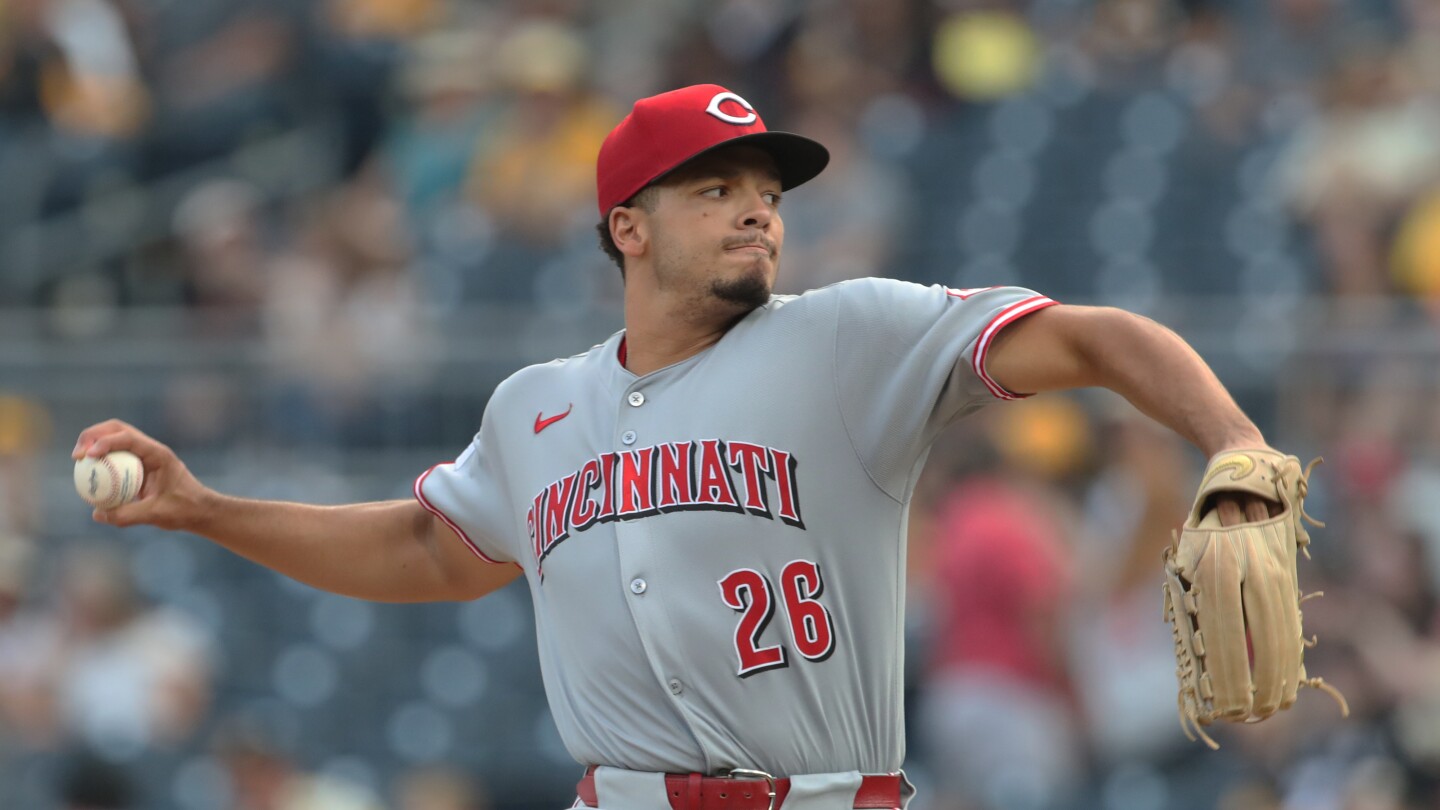
Last season was a huge success for the Cincinnati Reds. They secured their first playoff appearance in a full-length season since 2013 and tied for their most wins in a season since that same 2013 season. Still, there is more work to be done. The Reds haven’t advanced in a playoff series since 1995, and that was also the last year they won a home playoff game. But two players who weren’t even born then could be the driving force in getting the organization back to those heights.
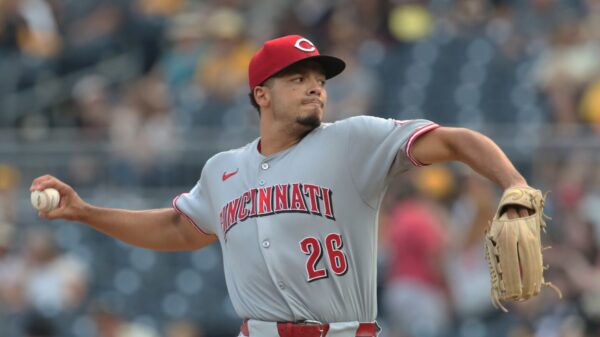
Chase Burns, who was born in January of 2003, is one of the most exciting young arms in baseball. He packs a 99 mph fastball that makes him and Hunter Greene perhaps the hardest-throwing starting pitcher duo in the Majors. In 43.1 MLB innings last year, Burns struck out 67 hitters and posted an impressive 16.7% swinging strike rate (SwStr%). But his debut season was not without its worries.
One of the biggest worries centers around Burns’ health. Last year, he suffered a flexor strain in mid-August and was placed on the injured list. When he returned, the Reds used him exclusively out of the bullpen, and there is some concern that, due to his elevated fastball velocity, Burns could be at increased risk of that flexor strain being the precursor to larger arm issues. However, the 23-year-old is confident that it won’t be an issue.
“It was kind of a minor thing,” he said before a spring training game in Arizona. “I just worked my way up [to the Majors] and was throwing with such high intensity in a short amount of time, short amount of rest. It was fine once I came back and hasn’t been bothering me at all, so it’s been a pretty healthy offseason.”
⚾️ Coming soon: MLB returns to NBC and Peacock in 2026! In addition to becoming the exclusive home of Sunday Night Baseball, NBC Sports will broadcast MLB Sunday Leadoff, “Opening Day” and Labor Day primetime games, the first round of the MLB Draft, the entire Wild Card round of the postseason, and much more.
Everything you need for 2026 fantasy baseball draft season.
The way Burns worked his way up was also impressive. The second overall pick in the 2024 draft, Burns started 2025 at High-A but made only three starts before being promoted to Double-A. In eight starts at Double-A, he posted a 1.29 ERA, 0.71 WHIP, and 36.4% strikeout rate, so the Reds moved him up to Triple-A. In just two starts there, he allowed three runs on seven hits in 12.1 innings while striking out 14 batters, and the Reds felt like he would be a huge help to their postseason push.
Yet, that quick rise to the big leagues came with some jarring changes for Burns: “I went through like, 40-something innings in the bigs,” he recalled. “That shorter off time throughout the week, and throwing more high intents on a bigger stage is a lot different.”
That increased intensity and limited rest time could have played a part in his mild flexor issue, but it also taught the young right-hander an important lesson in getting his body in the best place possible this offseason.
“I’m just making sure I’m staying on top of my body and listening to what my body says,” he detailed, when asked about his offseason focus. “Staying flexible and loose, and taking care of the arm. Staying healthy, of course, is a big [focus], so I’m working on everything that I need to work on to build up for the season, because I know it’s a long season.”
In addition to potentially impacting his health, the quick rise to the big leagues also caused Burns to alter his pitch mix. In particular, Burns dialed back on the usage of his changeup, which was a larger part of his arsenal in the minors. In his 43 MLB innings, Burns threw the changeup just 5.8% of the time, but it was an impactful pitch, particularly against lefties, with a 17% SwStr%.
“I feel like I had all my pitches in the minors,” Burns said. “With using a different ball and trying to get to the bigs as quickly as possible, I knew the best way was getting outs and getting strikeouts, so my focus was just trying to get to the bigs at that point. But now that I know what it takes to get up there, I feel like I need those other pitches to help me out.”
That has led to a “renewed focus” on his changeup, as he looks to make it a bigger part of his arsenal. It has also led Burns to play around with both a sinker and a curveball as well: “I experimented a little bit last year with [a sinker], just because my four-seam cuts and has ride, so there’s something a little bit different for the hitter to see. But another big one is my curveball, just having a slower pitch. I throw everything kind of hard, so just messing with the hitter’s tempo and timing a little bit.”
Of the trio of pitches, the changeup and sinker might be most impactful for Burns. Last season, he induced fewer whiffs against lefties than righties, and he seems to command his slider much better to righties, so the changeup would give him another swing-and-miss offering to lefties and reduce some of the emphasis on his slider. The sinker would also keep hitters off the four-seam fastball. While Burns throws hard, and his four-seamer can absolutely miss bats, he also allowed a nearly 48% Ideal Contact Rate on the pitch last year, which was 25th percentile among starting pitchers. Adding a different fastball variation will make it harder for hitters to make that kind of contact on his four-seamer.
Yet, at the end of the day, Burns’ rise to potential stardom will likely fall on the back of his slider. It’s already one of the better ones in the majors. It’s 91 mph with just about five inches of horizontal movement, so it’s more of a gyro slider than a big sweeper, but Burns has tremendous command of it. Not only does it register elite swinging strike rates, but its overall strike rate is high because Burns can put it in the zone if he wants or bury it off the plate, depending on the situation.
“I’m actively thinking and looking at a different spot,” he explained about his slider placement. “For in-zone, I’m trying to throw it at the hitter’s elbow, but late in the count, I’m trying to throw it right down the middle and just let it move naturally. I have a tendency of trying to do too much with it, trying to get that big swing and miss. The biggest thing for me is just staying directional and staying through the target. Then it takes care of itself.”
That’s another lesson that Burns learned in his brief MLB sample size after going up against hitters whose approach was far superior to anything he had seen in the minors.
“Triple-A to the bigs is the biggest jump for sure,” he admitted. “There are pitches that I’ll throw that I’m thinking they’re gonna swing and miss, and they don’t even bat an eye at it. These guys in the bigs are the best of the best. It doesn’t get any better than this, so just working on that and using that to my advantage, setting up hitters for certain counts, and making sure that I throw everything hard through the zone.”
The big jump between Triple-A and the big leagues is also something that Sal Stewart experienced firsthand last year. The Reds’ first-round pick in 2022, Stewart is the Reds’ top prospect and the 22nd-ranked prospect in all of baseball, according to MLB Pipeline. He began last year in Double-A, but after 80 impressive games, the Reds promoted him to Triple-A, where he hit .315/.394/.629 with 10 home runs, 36 RBI, and four steals in 38 games. The Reds decided that was enough to bring him up to the big leagues.
“These are the best pitchers in the world, from all over the world, and their stuff’s good,” Stewart said about his first impression of MLB pitching. “They locate well. A lot of them have been there for a while, so they know how to get it done. So you kind of just have to keep adjusting as the season goes on.”
Which was something Stewart did just fine last year. In his first eight games, Stewart was 4-for-24 with two home runs, three RBI, and an 8/0 K/BB ratio. Over his final 10 games and 34 plate appearances, Stewart went 10-for-31 with three home runs, five RBI, eight runs scored, and a 7/3 K/BB ratio. That increased success as the season went on taught him valuable lessons about his own process: “That my preparation is enough. Everything I do before the game starts is enough, so I just got to trust that and go out there and be me, do what I do. Go out there, play hard, play to win.”
What Sal Stewart does is hit the ball hard. He posted a 51.3% hard-hit rate in Triple-A and then came to the big leagues and registered a 52.5% mark with a 17.5% barrel rate and 95.4 mph average exit velocity. Stewart has good bat speed, but it’s not among the tops in the league; yet, his approach is designed to do damage.
“I’m in the game to change the game,” Stewart said matter-of-factly. “I’m not in the game to do anything other than that.”
Stewart does that in a few ways. For starters, in his brief MLB sample last year, the 22-year-old was among the league leaders in Pull Air%, which measures how often hitters get the ball in the air to the pull side. From 2022-24, 66% of all home runs were on balls pulled in the air. Yet, at the same time, he chases outside of the zone less than the league average and has always posted swinging strike rates around 10% and zone contact rates about 85%, which are good marks for somebody with his raw power.
“I just try to hit the ball hard up the middle,” he said about his approach. “If I’m a little out in front, then I pull it. If I’m a little late, then I go the other way. I just try to use my legs and stay behind the ball. Obviously, I take my walks, and I walk a lot, but I’m ready when the ball comes in the zone. From pitch one, I try to be ready to go, and if they come into the zone, then I get ready to go. If not, I’ll take first.”
Taking first is also something Stewart looks to do defensively as well. After playing the vast majority of his minor league games at third base or second base, the Reds started to move Stewart to first base late in his Triple-A season when a call-up seemed possible. With Ke’Bryan Hayes at third base, Eugenio Suarez at DH, and Matt McLain at second base, first base will need to be Stewart’s new home if he plans to get regular at-bats, but the Reds have also talked about using him at second base when McLain needs a day off. Not that any of that matters to Stewart.
“You got to do whatever Tito says. I’m surrounded by a lot of good teammates and great players, so wherever Tito puts me that day, I’ll go play defense, and I’ll work on my game. When you have a lot of really good players, you’ve got to do whatever it takes for the team to win. So I don’t see that as a problem at all [with moving positions].”
That team-first mindset is not rare for a young player who is looking to make his first Opening Day roster, but it is prevalent up and down the Reds’ roster and the sign of a team that knows that last year isn’t the final destination but just a small stepping stone.
“Team-wise, we want to go past what we did last year,” said Burns. “I think we had a good foot forward, and we added Geno and a lot of good guys, and I think that we can make a special run with these guys.”
It’s a sentiment that Stewart shares: “Obviously, everyone has personal goals, and the better you play, the more you help the team. So, yeah, I have personal goals, but the main goal is to help the team win. That’s my main focus.”
With these two young stars locked in and prepared to take their games to another level, the 2026 season may be the one where the Reds turn the clock back to the ‘90s.
Read the full article here