
























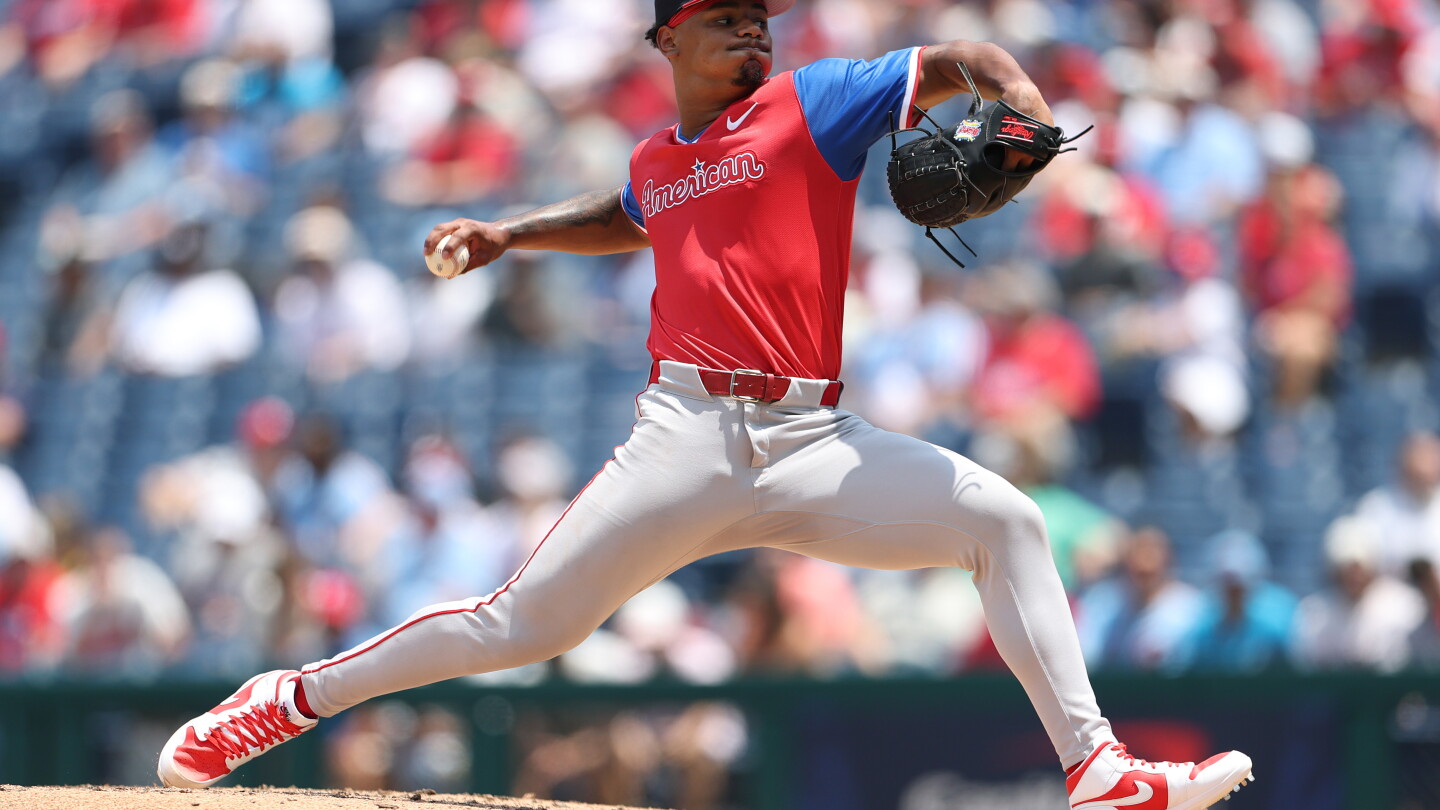
Monday’s MLB Trade Deadline featured over 30 unique trades. Even so, the name you heard discussed the most in the days that followed was a 21-year-old starting pitcher with only 30 professional starts to his name. Yet, Anthony Eyanson was one of the highest-ranked prospects traded at the deadline and the headliner in a shocking six-player trade that sent Baltimore Orioles catcher Adley Rutschman to the Boston Red Sox.
It’s been a quick and surprising path for Eyanson from starting pitcher at LSU to headline prospect in the biggest trade at the MLB deadline.
After transferring from UC-San Diego to LSU in 2025, Eyanson struggled to begin the collegiate season. However, he seemed to find his footing in the final two months of the season and eventually was a key contributor on a Tigers team that won the national championship. At the end of the season, he ranked third in NCAA Division I in both wins (12) and strikeouts (152 in 108 innings), and worked as a reliever to close out LSU’s final game in the NCAA regionals and then earned a win in the final games in the super regional and College World Series. Yet, some questions remained about his MLB future given that he had only one season at a top college program.
The Red Sox selected him in the third round of the 2025 MLB Draft, at 87th overall. Then immediately got to work on the key question that many had for Eyanson: his velocity.
“When I was first drafted, it was more so just continuing to live in the zone with all my pitches and really just focus on the velocity for me,” revealed Eyanson at this year’s Futures Game. “That was a big one…Just working to throw harder and throw everything harder in the zone more often.”
That velocity training covered a few different areas for Eyanson, including simply adjusting to a more demanding professional baseball schedule.
“For me, it was just a mix of throwing more,” reflected Eyanson. “I threw twice in college: in the bullpen and in the game, so hardly ever. Then just throwing a lot harder more often, just getting my body used to those higher outputs. Then pairing that up with training room stuff. You know, I’m in there about four, five times a week, and you know, weight room, just crushing the weights. That’s always been my thing, but just pairing those better with one another.”
That training led to crucial gains for Eyanson early in 2026. According to Ian Cundall, a prospect writer for Baseball America who focuses on Red Sox prospects, “Eyanson’s fastball velocity spiked into the high 90s this spring, and he touched 100 mph in the Spring Breakout game.” Considering Eyanson has a strong build at 6’2″ and 210 pounds, and is “a very good athlete, moves well and has a controlled, repeatable delivery,” the added velocity seemed like the missing piece.
In 16 appearances and 15 starts between High-A and Double-A this season, Eyanson has a 1.32 ERA, 0.89 WHIP, and 94/26 K/BB ratio in 68.1 innings. However, the development has not been fully linear.
According to Cundall, “In the regular season, [Eyanson’s] velocity has been down closer to where it was in college, as he’s sitting 92-95 mph and has maxed out at 97.1 mph.” As a result, “his strikeout totals declined in June, and his control came and went, but he righted things in July, striking out 30 in 17.2 innings.” He has a 12.4% walk rate in 48 innings at Double-A and a 32% strikeout rate, which is great, but not quite the 48% rate he posted in Single-A.
As Cundall noted, even at a lower velocity, Eyanson’s fastball still shows above-average bat-missing ability, but his ceiling becomes infinitely higher if he can find a way to hold that upper-90s velocity. Just because he hasn’t been able to do it in his first full professional season doesn’t mean he won’t be able to do it in the future. Particularly because Eyanson is also continuing to grow in terms of his understanding of the game and pitching mechanics.
“I think I’m mentally just in a different space [than at LSU],” he reflected. “I’m able to understand it more, with having more familiarity with it. I was kind of just worried about velo and vertical break when I was at LSU, but now there’s an understanding of the underlying factors that go into making a pitch nasty… For me, being a higher slot, I’m really pretty much just looking at my tilt, and how high I can get my arm up there in the slot, and that’s going to help me optimize my shapes for sure…I think I just had to increase my information and knowledge on that.”
Increasing his knowledge of his arm tilt and how he can optimize his pitch shapes has helped him round out his arsenal beyond his fastball. In Cundall’s scouting report, he noted that “Eyanson’s secondaries are quite impressive and the best part of his arsenal. His mid-80s gyro slider is his best pitch and has a whiff rate above 50%. He uses it almost as much as his fastball and has an advanced feel for it. He can command it in and out of the zone depending on the situation, and hitters struggle to square it up. His high-70s curveball also shows premium bat-missing ability, but is more of a chase pitch that is effective when used to finish off at-bats. His splitter also plays best when ahead in the count, as it has a strike rate around 50%, but when he lands it competitively, it’s hard for hitters to lay off it as it looks like a strike until falling off the table late.”
In his own words, developing that splitter has been a big focus for Eyanson: “I think that’s something that I’ve taken good strides in first at High-A and also at spring training.”
Yet another piece of the puzzle for Eyanson is the introduction of a new cutter, which is a staple pitch in the Red Sox organization. Eyanson laughed when asked if all of the pitchers were asked to throw one, but he did acknowledge that it’s a pitch he thinks has been a good weapon for him.
“I’ve had some good results with that [cutter], so that’s been going pretty well. I’m just continuing to hammer that down…For me, it’s something that’s helped me have a medium between the fastball and the slider, and just make every pitch a little bit better because you can’t sit on four, you have to sit on five. So that’s pretty much how I see it.”
A true five-pitch mix with a repeatable delivery and a bat-missing fastball is certainly the profile of a pitcher any team would be excited to have, and the caliber of talent it would take to land a player like Adley Rutschman. All of that gives Eyanson the profile of a mid-rotation starter. However, if the Orioles can find some way to get the 21-year-old to maintain the velocity he flashed in the spring, his ceiling would be even higher. That would be a pretty major win for an Orioles organization that has struggled to produce a difference-making starting pitching prospect.
Read the full article here