



When we talk about sports, we talk a lot about a player’s “athletic prime,” but what does that mean and why does it matter?
Quite simply, an athlete’s prime is an age range in which they perform at their best. Research supports the existence of an athletic prime, and while it varies by sport, Ron Shandler’s Baseball Forecaster notes that a baseball player’s athletic prime is between ages 26 and 29. While some athletes have their best seasons before or after this range, research indicates that this is when muscle development, flexibility, regenerative health, and other factors peak, putting a baseball player in their peak physical condition.
So what do we do with that information: only draft players between the ages of 26 and 29?
Not quite; however, I thought it would be interesting to see which hitters in their athletic primes could be in for mini-breakout seasons. Last year, when I wrote this article for the first time, I landed on Vinny Pasquantino, Jonathan Aranda, and Josh Naylor, which was great, but also on Trevor Larnach, Pavin Smith, and Lars Nootbaar, so it wasn’t a complete hit. However, I think it was successful enough to try it again.
After sorting by age to create an initial leaderboard, I looked at hitters who produced above-league-average value in a few of the categories I like the most when it comes to hitters: walk rate, strikeout rate, chase rate, barrel rate, swinging strike rate, and contact rate. The goal of this endeavor is to find hitters who are entering their prime years and may not have had the surface-level breakout year but have proved to have above-average plate discipline, contact rates, and quality of contact. By doing that, we can hopefully land on some hitters who could be in for breakout seasons in 2026.
Fantasy Baseball Breakout Hitters for 2026
All ADP data is taken from NBC Online Championship drafts (12-team redraft leagues) from March 13th to March 21st (43 drafts)
| Name | AVG | O-Swing% | Barrel% | SwStr% | Contact% |
| League Average | 28 | 8.3 | 10.7 | 77.3 | |
| Ben Rice | 0.254818 | 0.211873 | 0.153639 | 0.084961 | 0.803833 |
| Jahmai Jones | 0.286822 | 0.215017 | 0.134021 | 0.102521 | 0.773234 |
| Brett Baty | 0.254453 | 0.23995 | 0.128028 | 0.109846 | 0.76319 |
| Wilyer Abreu | 0.246649 | 0.281843 | 0.123188 | 0.113054 | 0.781928 |
| Andrew Vaughn | 0.253695 | 0.297619 | 0.12012 | 0.0964 | 0.795539 |
| Iván Herrera | 0.283505 | 0.233689 | 0.109677 | 0.09508 | 0.786241 |
| Lars Nootbaar | 0.233792 | 0.21492 | 0.101523 | 0.076239 | 0.805405 |
| Alejandro Kirk | 0.281596 | 0.285417 | 0.100503 | 0.077273 | 0.836188 |
| Bo Naylor | 0.194986 | 0.265725 | 0.096654 | 0.095719 | 0.79646 |
| Miguel Vargas | 0.234127 | 0.210477 | 0.093366 | 0.080825 | 0.823694 |
| Brendan Donovan | 0.286957 | 0.245198 | 0.087719 | 0.053042 | 0.877844 |
| Heliot Ramos | 0.256452 | 0.29845 | 0.087607 | 0.104253 | 0.781373 |
| Spencer Steer | 0.237721 | 0.253177 | 0.075718 | 0.112263 | 0.764919 |
| Adley Rutschman | 0.220497 | 0.225138 | 0.074906 | 0.053655 | 0.866116 |
| Otto Lopez | 0.246324 | 0.280561 | 0.070968 | 0.07891 | 0.829615 |
| Spencer Horwitz | 0.271978 | 0.252207 | 0.082192 | 0.075972 | 0.836943 |
| Ryan Jeffers | 0.26601 | 0.229847 | 0.063291 | 0.074389 | 0.806849 |
There’s a case to be made that Ben Rice (ADP: 52) has already “broken out,” but I wanted to include him here because I think there’s another level for him to reach. I always wanted to include Jahmai Jones (ADP: Undrafted) in this article, even though he doesn’t have a starting job, because I was surprised to see his name come up, and now I’m going to keep an eye out for him if he were to find himself in a situation where he was getting regular at-bats. Lars Nootbaar (ADP: Undrafted) is also starting the year on the IL after heel surgery, so he’s just a name to keep an eye on when he makes his way back. Brendan Donovan (ADP: 263) is also on this list, but he’s moving to the worst park in baseball for left-handed hitters, and so I have a hard time expecting him to make any meaningful gains from what we’ve seen in his career.
I also wrote about a few of these guys already, so you should check out the detailed write-ups in previous articles. Brett Baty and Bo Naylor (ADP: 345) were in my post hype hitters article. Spencer Horwitz (ADP: 361) and Miguel Vargas (ADP: 301) were featured in my article on Process+ leaders. Adley Rutschman (ADP: 150) showed up in my bounce-back hitters article, and Spencer Steer (ADP: 294) was in my article on Pull Air% leaders.
Wilyer Abreu – OF, Boston Red Sox (ADP: 200)
Abreu already had a bit of a mini breakout last year, slashing .247/.317/.469 with 22 home runs and six steals in 115 games, but I think the limited games played have people forgetting just how good he was. Remember that Abreu, like Mookie Betts, had an illness near the end of spring training, which caused him to have his playing time managed a bit early on. Then he had an oblique injury and a calf injury, but he doesn’t have a long track record of soft tissue injuries, so this isn’t something I’d worry about. He has a league-average chase rate and an above-average walk rate, paired with a 12.3% barrel rate, which means we’re getting a good approach at the plate with above-average quality of contact. His swinging strike rate (SwStr%) is slightly worse than league average, but when you have that kind of natural power, it’s not a major issue, and his overall contact rate is better than league average anyway.
The Red Sox have also said that Abreu is going to get more plate appearances against left-handed pitchers this year. While he is not as good against them, he hit .230/.299/.377 with a 20.6% strikeout rate in 68 plate appearances against lefties last year, so he certainly deserves more opportunities. He also sported a .277 BABIP overall last year, but has a career .314 BABIP, so I think he could be a .250 hitter or better in 530 or more plate appearances, which would give him a shot at 25 home runs and 10 steals while hitting in the middle of that lineup. That’s a real value at this ADP.
Iván Herrera – DH/C, St. Louis Cardinals (ADP: 185)
Herrera would be going a lot earlier in drafts if he had catcher eligibility in all formats. His offseason knee surgery may also cause him to take a little while to pick up catcher eligibility this season in formats where he doesn’t already have it, so that is certainly something that fantasy managers need to keep in mind. That being said, as a hitter, he looks ready to explode after hitting .284/.373/.464 with 19 home runs in 452 plate appearances. Much like Abreu, this draft price and public perception have been impacted by injuries and plate appearances. With the Cardinals in tanking mode, there is a good chance that Herrera could still get DH at-bats when he is ready to catch. That could make him a catcher who gets over 500 plate appearances, which is rare. Given he has a better-than-league-average walk rate, strikeout rate, chase rate, barrel rate, swinging strike rate, and contact rate, if he’s going to get 500 plate appearances, then I want him on my teams. I would even consider using him in my UTIL spot if I’m in a league where he could get catcher eligibility soon. If I’m in a Yahoo format where he already has it, then I’d take him as a top 6-7 catcher.
Andrew Vaughn – 1B, Milwaukee Brewers (ADP: 270)
I wrote about Vaughn recently in my Process+ article, but I thought it was worth sharing that insight again. Vaughn made his debut with the Brewers on July 7th, and his time there was impressive. He hit .308/.375/.493 with nine home runs and 46 RBI in 64 games. He also posted an 11% barrel rate and 47.4% hard-hit rate while also displaying well above league-average swing decisions and contact ability, plus better-than-average power. It’s also important to point out that Vaughn was never really bad with the White Sox. In 2024, he hit .246/.297/.402 with 19 home runs. In 2023, he hit .258/.314/.429 with 21 home runs. He also posted barrel rates of 9.3% and 8.4%, respectively, and averaged abouta 45% Hard-Hit rate. So now you take that same hitter, you cut down his chase rate a bit, you put him in a better home park and a better lineup, and it makes sense that you get better production. I think Vaughn is a legit .270 hitter with 20-25 home run power who will hit in a decent lineup. I’d even take him as my 1B in deeper formats.
Alejandro Kirk – C, Toronto Blue Jays (ADP: 163)
What do you know, another catcher. Unlike Herrera and Abreu, I do think that Kirk finally broke out last season, so I’m not predicting more from him as much as highlighting that he qualified for this list and should be in for another good season. Last year, he hit .282/.348/.421 with 15 home runs and 76 RBI in 506 plate appearances. He saw a huge uptick in his barrel rate to 10.1%, and that coincided with a 10% jump in hard-hit rate and a big improvement in his average exit velocity. While some of that could just be that he was healthy, Kirk also improved his bat speed by two mph last year and seemed to attempt to elevate the ball more, trading a touch of contact ability for some more thump. That’s certainly a trade-off he can afford to make since he’s a career 90% zone contact hitter with a 6.4% SwStr%. I’m not sure there’s another level here, but I think we can expect this level of production again, perhaps with another few home runs as well. That makes Kirk a clear target for me, especially if I wait in one-catcher formats.
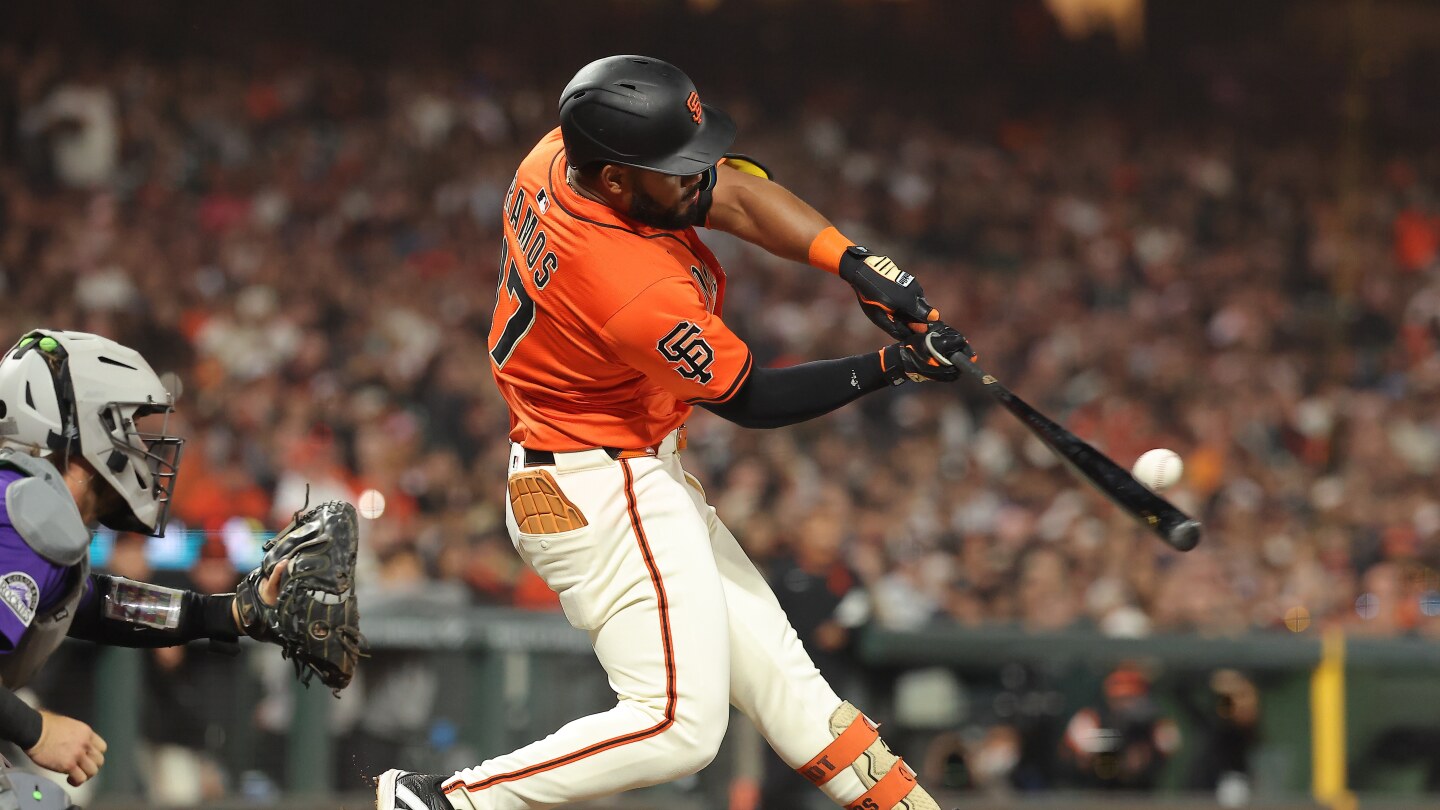
Heliot Ramos – OF, San Francisco Giants (ADP: 217)
For the last two seasons, Heliot Ramos has put together some solid production, but now he’s entering his age-26 season, so a breakout is on the way. OK, that’s not really how it works, but it is worth noting that he is entering his “peak” athletic years after two solid seasons of production for the Giants. Last season, he slashed .256/.328/.400 with 21 home runs and six steals in 157 games. Will he play 157 games again? Probably not, but I still think you’re going to get a similar amount of production from him, if not more.
Ramos does fall just under our cut-off at walk rate (7.5%) and chase rate (29.8%), but he’s within a narrow margin of error, so I thought it was worth including him here. Partially because so much of what he does is above league average. His 87.3% zone contact and 78% contact rate overall are good for a player with a 92 mph average exit velocity and 11.3% career barrel rate. He also improved his SwStr% by over 3% last year, thanks to cutting down on his swing rate and being a bit more selective. I also found it interesting that his barrel rate fell from 14.5% in 2024 to 8.8% in 2025 despite an identical hard-hit rate and a marginal one-degree change in launch angle. He also saw his HR/FB rate decrease from 17.3% to 11.9% despite his average exit velocity being the same and his fly ball rate changing by just 1%. He also pulled the ball in the air MORE in 2025 despite all of those numbers going down.
When you dig in, you can see that Ramos’ first and second half splits are noticeably different. From the beginning of the season until July 20th, he slashed .267/.338/.431 in 98 games with 14 home runs and five steals. He also had a 10.7% barrel rate and 37% fly ball rate. From July 21st on, he hit .240/.312/.352 with seven home runs in 59 games, while posting a 5.9% barrel rate and 39% fly ball rate. Why does that date matter? Well, Ramos himself said after the season that he could pinpoint that exact day as the day he started to spiral mentally due to his poor defensive performance. Defensive struggles can absolutely be carried over into the batter’s box, and Ramos was clearly not himself after that. His launch angle got a bit out of whack. He stopped making contact with as much authority as he had before, and the power dried up a bit. Ramos mentioned in that article that last season was also his first full MLB season, and it was a lot to adjust to, mentally. I think we’re going to see clear improvements for him with another season under his belt. We could get that first half production for a full season and see a .260-.270 hitter with 25+ home run power, which would be tremendous value where he’s going in drafts.
Brett Baty – 2B/3B, New York Mets (ADP: 282)
Baty is another player I’ve written about who I think is going too late in drafts, so I wanted to highlight my thoughts on him here. Baty got off to a poor start in 2025, slashing .204/.246/.352 in the first 18 games of the season before being demoted. When he was called back up a few weeks later, he looked like a different hitter and would go on to slash .266/.327/.454 in 110 games the rest of the way with 17 home runs, seven steals, and a 24% strikeout rate. In that latter stretch, Baty chased less outside of the zone and allowed himself to get behind in counts rather than attack pitches early that he couldn’t do damage on. However, his early called strike rate decreased, so he wasn’t simply letting the first pitch go by. His overall swinging strike rate dropped, and his barrel rate jumped to 13% while both his max exit velocity and average exit velocity were career highs. His new profile has all the makings of a breakout, so the only reasons why we’re not drafting him as such are that he’s been demoted a bunch before and/or we don’t feel confident in his playing time. Well, past demotions shouldn’t cause us to overlook the clear changes he made, and I think there’s a really good chance he’s the starting designated hitter for the Mets against right-handed pitching. When you add his ability to play second base, third base, and potentially even left field if the Mets need to give somebody an off day, there is still a path for Baty to push for 500 plate appearances this season, which makes him a real value at his draft price.
Otto Lopez – 2B/SS, Miami Marlins (ADP: 236)
Lopez has a reputation as a slappy-type hitter with good speed, but I think he could be a bit more than that. Yes, his barrel rate was below league average, but a 7.1% mark is not that soft, and his nearly 72 mph bat speed is pretty good. Lopez has plus contact ability and an 8.8% career SwStr%, so we know he’s going to put the bat on the ball. Last year, he started doing that in the air a bit more, raising his flyball rate nearly 10% to 34.1%. That was at the expense of some line drives, and pulls the ball in the air only 11% of the time, while hitting the ball in the air to center field and oppo over 20% each. If he’s going to lift the ball a bit more, I’d love to see him do so more to the pull side and less to the opposite field. He did start to do that a bit as the season went on, and 10 of his 15 home runs came to the pull side, so that approach could help him cement himself as a consistent 15-20 home run hitter; I don’t think we should expect more.
That being said, I do think we should expect a better batting average. His .264 BABIP last year was below the .318 mark he posted in 2024, and his .270 xBA also suggests that he got a bit unlucky on balls in play. Considering he has decent bat speed and a good enough barrel rate, I don’t see any reason why Lopez can’t be a .260 hitter with 15/15 as a baseline for his homers and steals and 20/20 as his upside. The lineup around him isn’t great, which will hurt his counting stats, but he figures to hit sixth, which should help his RBI totals. That’s the profile of a solid MIF target in deeper formats, or if you wait in your drafts.
Ryan Jeffers – C, Minnesota Twins (ADP: 271)
Hey, why not finish with another catcher? Much like with Ivan Herrera, Jeffers’ “breakout” may just come with playing time. Yes, the Twins brought in Victor Caratini to be the backup catcher, but the rest of their lineup is a bit depleted and also lacks a natural right-handed counterpart to a few left-handed bats that they’ll want to platoon. That makes it seem likely that Jeffers could be the regular designated hitter against lefties and also start behind the plate about four games a week. That’s a recipe for over 500 plate appearances, which would be a career-high for Jeffers.
Another big reason that we should expect more from Jeffers in 2026 is that he played much of last season after suffering a hand injury. On June 17th, Jeffers was hit on the hand with a pitch and left the game. X-rays were negative, and Jeffers was back in the game two days later, but the power production tapered off a bit after that. Before the hand injury, he had an 8.2% barrel rate, 43% hard-hit rate, and 90 mph average exit velocity. After, he posted a 4.8% barrel rate, 42% hard-hit rate, and 88.7 mph average exit velocity. His Pull Air% also fell from over 19% to just under 17%. These are not major, glaring issues, but they are signs of a player who is not making the quality of contact that we’re used to seeing. Especially considering Jeffers has a career 10% barrel rate. He has also posted better-than-league-average contact rates over the last two seasons and cut his SwStr% down to 7.4% last year. I think he actually wound up being a bit too passive, but his zone swing rate is back to where we want it this spring training, so maybe Jeffers felt that way as well. At the end of the day, I think he’s probably a .250 hitter, but I do think he can get back to 20 home runs while pushing 130 Runs+RBI in a bigger role in 2026. That makes him a great two-catcher league option, but also a decent gamble in one-catcher formats if you wait until the final rounds to select your catcher.
Read the full article here