








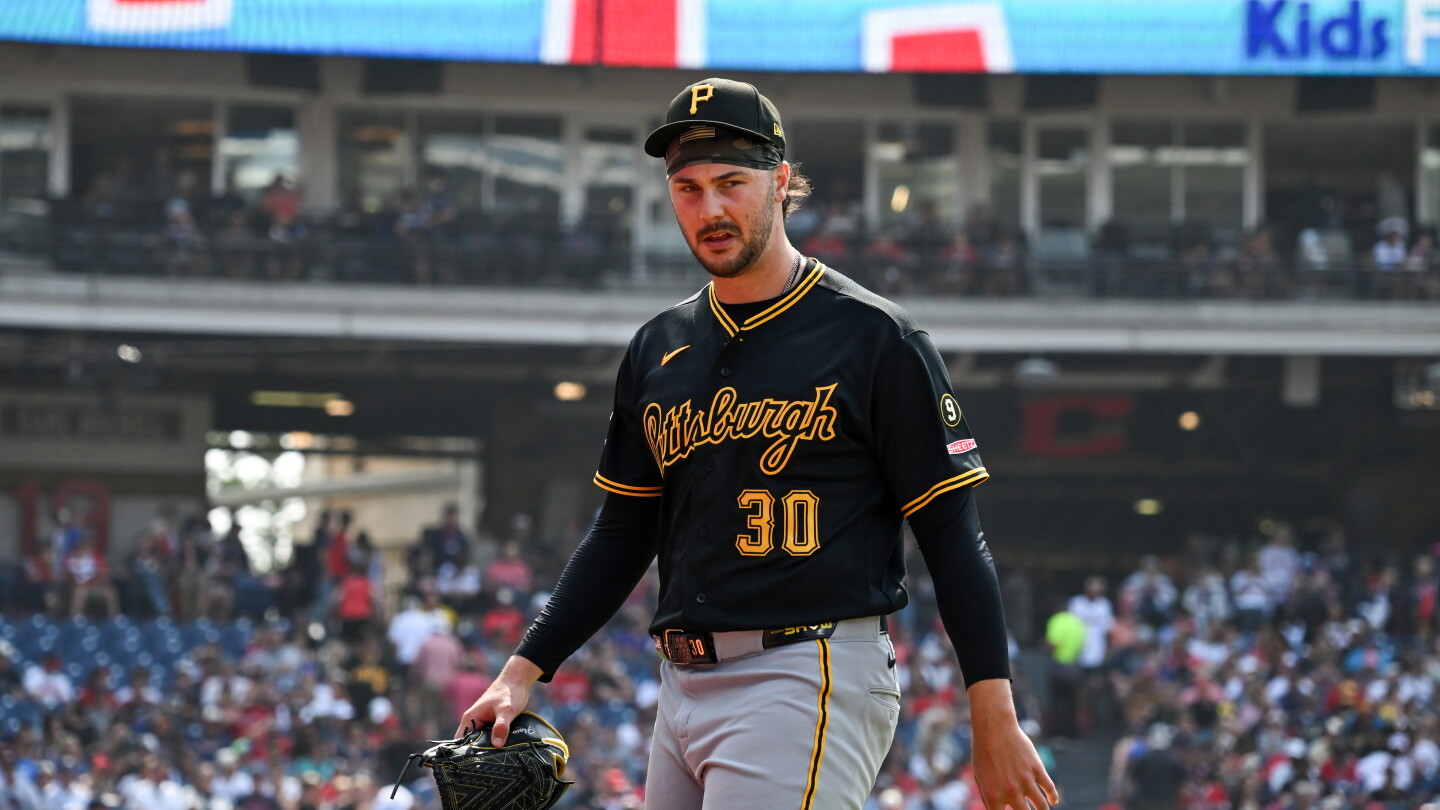
In a starting pitching landscape filled with uncertainty and inconsistency, Paul Skenes was supposed to be a given. He was the consensus top prospect in the 2023 MLB Draft, blitzed through the minor leagues in just 17 starts, and posted sub-2.00 ERA seasons in each of his first two MLB years. He came into this season just 24 years old and set to dominate the sport for years to come.
But somewhere along the way, things went sideways.
It began on Opening Day, when Skenes couldn’t even make it out of the first inning against the Mets, allowing five runs on four hits in two-thirds of an inning. People wondered whether his 8.1 innings in the World Baseball Classic had caused him to ramp up too quickly in the offseason. Yet, that Opening Day game was characterized by poor defense and bad luck and seemed like more of a fluke than anything.
Skenes allowed more than one run in just one of his next eight starts, and it seemed like we were right back on track.
Yet, here we are, on August 11, asking ourselves how Skenes could possibly have a 3.96 ERA and 1.12 WHIP in 129.2 innings for the Pirates this year. How could he also take that big of a step backwards while also increasing his strikeout rate and K-BB% from last year while posting an identical swinging strike rate (SwStr%)? None of it seems to add up, so it’s time we dig in a little deeper to find out what’s wrong with Paul Skenes in 2026.
Mechanical Changes
We can get into Skenes’ fastball velocity and individual pitch performance, and we will, but underlying all of this, there’s one mechanical change that could connect everything. Skenes has increased his arm angle by three degrees this season (see image below), and it’s up on every single pitch he throws.
It’s unclear why this has happened. You can read theories that he has put on too much weight or that he’s compensating for a dead arm, but none of that has been reported. So all we know is that Skenes has raised his arm angle three degrees, and it’s led to small shape changes on all of his pitches. His four-seam fastball has 1.4 inches more rise and 1.6 inches less arm-side run. His sweeper has 1.4 inches less sweep. His changeup has 1.3 inches less arm-side run and 1.2 inches less drop. His sinker has 2.1 inches more rise. You get the point.
The shape changes have led to changes in how close batters are getting to his pitches. Thanks to Statcast’s new Swing Timing Leaderboard, we can see just how much batters miss Skenes’ pitches by. The biggest change has been with his slider. In 2025, hitters missed his slider by 5.1 inches on average, but they are missing by 3.1 inches on average in 2026. His sweeper miss distance fell from 4.6 inches to 3.8 inches, the same exact numbers as his changeup, and his sinker miss distance fell from 1.7 inches to 1.2 inches.
So, across the board (except on his four-seamer), hitters are swinging and missing by less on each individual pitch than they were in 2025. But here’s the deal: they’re still swinging and missing. We have more data on this later, but, for example, hitters are whiffing MORE on his slider this year despite the miss distance being smaller. Which is actually useful because it’s telling us that hitters getting closer to the ball isn’t translating into more contact overall, but when they do make contact, the quality of contact has gotten better.
Skenes’ Quality of Contact is Getting Worse
This is another confusing situation because Skenes isn’t actually getting hit much harder. His average exit velocity allowed is 87.4 mph, which is up just 0.1 mph from last year. His xwOBA on contact is .346, up from .328 last year and well below the .369 league average. His barrel rate has gone up 1.2%, but he’s still sporting an above-average 6.8% barrel rate, and his hard-hit rate allowed actually improved to 39.3% from last year’s 40.1%.
So it’s not simply that Skenes is getting hit harder, but it’s that hitters are making the most of their contact more often.
Skenes is throwing pitches in the heart of the zone less often than the MLB average; however, hitters are swinging at those pitches far more often than average, suggesting batters may be trying to be more aggressive against Skenes this season. Skenes’ early called strike rate has fallen from 20.8% to 18%, which would support the idea that hitters are trying to be more aggressive when he comes into the zone at the beginning of counts.
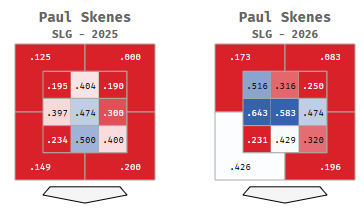
On pitches in the heart of the strike zone, he’s giving up a .477 xwOBA this season, which is up significantly from .371 last year. A simple Statcast search also shows that, on pitches in the heart of the zone, Skenes is giving up batted balls with nearly a 2 mph increase in exit velocity and a significant increase in xSLG (see image below). All of which is to say that even though the overall quality of contact against Skenes isn’t massively different from 2025, hitters are taking advantage of his mistakes or when he comes into the zone far more often than they did in previous years.

Skenes’ Sinker Could be the Main Issue
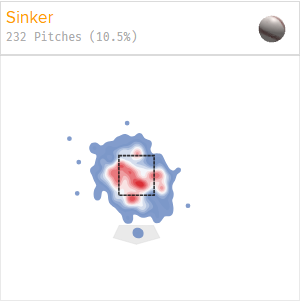
If you’re looking for a pitch that could be at the root of Skenes’ larger issues, it might be his sinker. I mentioned above that his sinker shape has changed slightly from last season, and his release height on the pitch has also increased from 1.94 feet to 2.29 feet. That could be impacting his command. Last year, Skenes had just a 43.6% zone rate on his sinker, which was 7th percentile among starting pitchers. Yet, the pitch missed more bats than the average sinker and rarely gave up any barrels. This season, his zone rate has increased to 47.8%, but throwing more sinkers in the zone has not been good for Skenes.
The command of his sinker in the zone has been an issue. According to Pitcher List data, Skenes has thrown his sinker middle on the x-axis (meaning not away or inside) 31.7% of the time this season. He only did that 25.7% in 2024 and 27.1% of the time last year. He’s also thrown his sinker in the middle on the y-axis (meaning not up or down) 31.3% of the time this year. That’s up from 24.4% last year and 23.5% in 2024. So Skenes is zoning his sinker far more often than he ever has before, locating it in the middle of the zone more than he has before, and has seen his hard-hit rate on the pitch spike to 54.5% and his barrel rate increase to 4.5% (up from 2.9%).
Why has Skenes’ sinker command started to fail him? Is it due to the mechanical changes? Is it a conscious approach shift? Whatever it is, his whiff rate and swinging strike rates on the pitch have collapsed, and hitters have a 90.6% contact rate and 95% zone contact rate on the pitch. That’s up from 79.6% and 89.8%, respectively, in 2025.
That’s not going to work.
Skenes’ Four-Seamer Usage Has Changed
Perhaps the biggest difference for Skenes from 2025 to 2026 has been his four-seam locations and usage.
As I mentioned above, Skenes has added vertical movement to his four-seamer this year and is clearly trying to elevate it more often than he did in 2025. He has a 72.2% high location on his four-seamer this year, up from 50.3% last year. That’s a massive jump. Skenes has also seen his whiff rate increase meaningfully from 23.9% to 27.7%, while his swinging strike rate has gone from 15.2% to 17%. So you can talk all you want about his four-seam velocity being down, but the pitch is a much better swing-and-miss pitch this year.
Yet, what’s interesting is that Skenes has not been more effective with the four-seamer inside the zone but is actually elevating it above the strike zone more than before.
His rate of high fastballs in the strike zone has gone from 30.1% in 2025 to 30.5% in 2026. However, his rate of four-seam fastballs above the zone has
nearly doubled, from 20.8% to 38.7%. That’s a big reason the O-Swing% on his four-seamer has climbed from 29.1% to 39% while his called strike rate has fallen from 17.2% to 12.9%. Skenes is intentionally (we assume) missing above the zone with his four-seamer to get whiffs, but, surprisingly, it hasn’t actually led him to more success in two-strike counts. Skenes is actually throwing the four-seamer less often in two-strike counts, and despite getting more chases outside of the zone in those counts, his PutAway Rate, which measures how often a two-strike pitch results in a strikeout, is basically the same as last year.
In two-strike counts alone, his rate of above-the-zone four-seamers has gone from 30.9% to 47.6%. So even though he’s getting many more chases outside of the zone, he’s just throwing so many more fastballs above the zone that the overall success of that pitch in two-strike counts is unchanged because batters are also laying off enough of them. He’s also seen a decrease in strikes and whiffs in the top third of the strike zone because he’s attacking above that more often now.
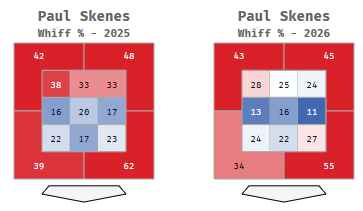
So Skenes’ fastball has become a better swing-and-miss pitch overall and in two-strike counts, but the improvement is offset by an increase in his rate of elevated four-seamers, which has led to no real improvement as a two-strike pitch. Pitcher List also has his “Quality Pitch” percentage on his four-seamer dropping from 50.6% to 47.2%, so he may need to be less aggressive with how often he attacks above the strike zone.
That similar conundrum is true of the contact results against his four-seamer. By elevating the four-seamer more often, his hard-hit rate and xwOBA are down. However, his HR/FB rate on four-seamers has gone up from 8.3% to 11.6%, allowing the same number of fly-ball home runs off his four-seamer (5) off fewer total fly balls.
So his four-seamer is missing more bats, but not missing more bats in two-strike counts. It’s allowing less hard contact but also allowing more home runs on that limited contact. It’s getting tons of chases outside of the zone but perhaps too often being thrown outside of the zone. Another confusing mix of both good and bad that has become consistent in this deep dive.
Slider is Missing Bats But Also Getting Hit Hard, Sweeper is Not Getting Low
The last pitches we’ll dig into in detail are his sliders.
For starters, his sweeper has seen its swinging strike rate fall from 14.8% to 12.2%. Skenes is throwing it in the zone less often, and it’s returning fewer strikes. Perhaps that could also be because of the shape change we discussed all the way at the beginning, but his command of the pitch has gotten less precise. Last year, he threw the sweeper low in the zone 51.7% of the time, but that has fallen to just 44.3% this season. As a result, his two-strike chase rate has plummeted from 22.4% to 13.9%, and he’s stopped throwing the sweeper in two-strike counts as often.
His slider has seen its swinging strike rate improve from 15.7% to 22.7%, and its locations are much better, with a 28% increase in low location rate. As a result, Skenes is using that slider 49.1% of the time in two-strike counts, up from 23.3% last year, and it has a 30% PutAway Rate and 36.3% two-strike chase rate, both of which are well above average.
All of that seems great, but his hard-hit rate on the slider has more than doubled, from 17.6% to 40.0%, and his xwOBA has nearly doubled too. So he’s locating his slider better, has cut his mistake rate on the pitch in half, is missing far more bats, but also giving up much harder contact on the pitch. The average location rates we see on Pitcher List may be masking a split where Skenes has some really good locations and some real mistakes; however, the mistake rate is down, which makes that harder to believe. We could just be seeing a small-sample effect, since we’re only talking about 18-25 total balls in play on the slider across both seasons.
He’s Suffering from Some Bad Luck/Poor Defense
The last component here is simply that Skenes has been dealing with some bad luck and a poor defense.
He has a .292 xOBA but a .270 xwOBA, which is actually flipped from what happened in 2024 and 2025. He also has a .223 batting average against but a .208 xBA. His xERA of 3.00 and his SIERA of 3.07 are nearly a full run better than his actual ERA of 3.96. These don’t seem like massive gaps, but his actual results are worse than the contact quality alone explains.
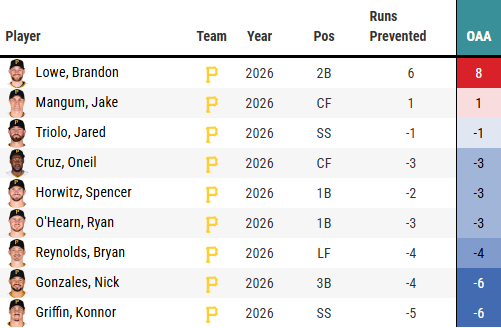
The Pirates team defense has also declined in 2026. Last year they ranked 7th in the majors in Outs Above Average at +18, but this year they are 23rd (-14). They also rank 22nd in Defensive Runs Saved at -1, while they finished 10th last season with a Defensive Runs Saved of +32. Those are massive swings, not marginal ones.
This was part of the gamble the Pirates took in the offseason when they tried to improve their offense. Signing Marcell Ozuna to be their DH meant that Ryan O’Hearn had to play the outfield a lot. Even when Ozuna was no longer a part of the lineup, the Pirates had replaced Ke’Bryan Hayes at third base and Isiah Kiner-Falefa at shortstop with players who are a clear defensive downgrade.
Last year, Hayes put up a +15 Outs Above Average at third base, while Jared Triolo had a +6 at shortstop and Kiner-Falefa was +1. Nick Gonzales was also a +4 Outs Above Average at second base, but he has been a -6 at third base. That’s a gap of 21 from Hayes to Gonzales. Meanwhile, Triolo’s defense at shortstop got worse, and Konnor Griffin graded out really poorly in his starts as well before he got hurt.
Final Takeaway on Paul Skenes
My takeaway after this long deep dive is that Paul Skenes is not broken and has not lost his stuff. His strikeout ability is arguably better than it was last year, and his general approach of using his four-seamer up in the zone and his slider/splitter beneath it makes tons of sense. He’s also not allowing that much more contact or harder contact, but hitters are making the most of the contact they’re getting in a way that wasn’t true in previous seasons. Pair that with a mechanical shift that has led to shape changes and worse locations on a few pitches, and you get a picture of a few minor tweaks combining with bad luck and poor defense to snowball into a worst-case scenario.
Maybe Skenes is pitching through an injury. Maybe this will be a lost season until he can do a biomechanical deep dive and fix his arm angle change. However, it’s also just as likely that the luck starts to bounce his way, his command slowly gets back to levels we’ve seen previously, and he ends the season on a hot stretch.
It’s just impossible to say which way things will go for Skenes this season because the whole year has been a riddle that doesn’t quite make sense.
Read the full article here